

Medically reviewed by Dr. Shreyaben Anilkumar Patel (Reg. GPC-20492) on 7 Oct 2026.
Key takeaways
- Most ankle sprains are ligament injuries that heal well with early, guided movement rather than long immobilisation.
- In the first 72 hours, protect, rest, ice, compress and elevate — then start moving within comfort.
- You may need an X-ray if you cannot take four steps or have bone tenderness at specific points.
- Balance and strength training are essential; without them, repeat sprains are common.
- Return to sport only after hopping, running and cutting are pain-free and confident.
In this article
- What happens in an ankle sprain?
- Do you need an X-ray?
- First 72 hours: what to do
- Rehabilitation exercises
- Phase 1 – Movement
- Phase 2 – Strength
- Phase 3 – Balance (the most important phase)
- Phase 4 – Return to sport
- When can I return to sport?
- Common mistakes that slow recovery
- Preventing ankle sprains in sport
- Other sports injuries we treat
- Sports injury physiotherapy in Himatnagar
An ankle sprain is one of the most common sports injuries — on the cricket ground, the football field, the volleyball court, or simply on an uneven road. Many people rest until the pain fades and then return to sport, only to sprain the same ankle again months later. Proper ankle sprain treatment with physiotherapy restores not only strength but also balance and joint control, which is what really prevents re-injury.
What happens in an ankle sprain?
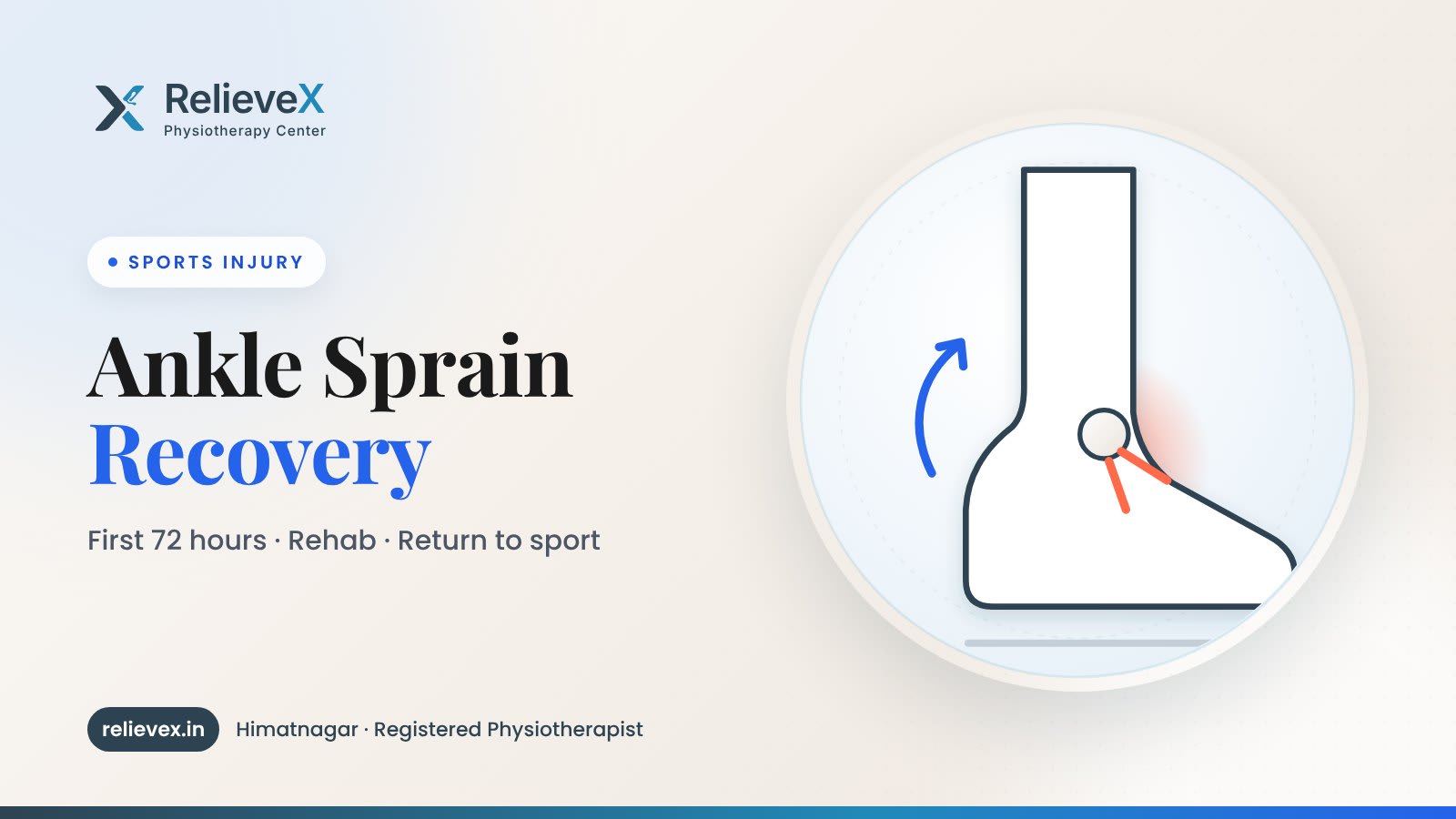
Most sprains happen when the foot rolls inwards, stretching or tearing the ligaments on the outside of the ankle. Sprains are graded by severity:
| Grade | What it means | Typical recovery |
|---|---|---|
| Grade 1 (mild) | Ligament stretched, mild swelling | About 1–3 weeks |
| Grade 2 (moderate) | Partial tear, more swelling and bruising, some looseness | About 3–6 weeks |
| Grade 3 (severe) | Complete tear, significant swelling, unstable ankle | Several weeks to a few months |
Do you need an X-ray?
Doctors often use the Ottawa ankle rules. An X-ray is usually recommended if, after the injury, you cannot take four steps on the ankle, or there is tenderness over specific bony points — the back edge or tip of either ankle bone, the base of the fifth metatarsal (outer midfoot) or the navicular bone (inner midfoot). If in doubt, get checked to rule out a fracture.
First 72 hours: what to do
- Protect – avoid activities that cause sharp pain; use crutches if walking is very painful.
- Rest – a short rest, not complete immobility.
- Ice – 15–20 minutes every 2–3 hours, wrapped in a cloth.
- Compression – a crepe bandage to control swelling (not too tight).
- Elevation – keep the ankle above heart level when resting.
- Avoid in the first days: heat, alcohol, vigorous massage and running.
Move early: Once the first painful days pass, gentle movement and walking within comfort speed healing. Long periods in a cast or tight bandage are rarely needed for ordinary sprains.
Rehabilitation exercises
Phase 1 – Movement
- Ankle alphabet – Sitting, “write” the alphabet in the air with your big toe. 1–2 times a day.
- Calf stretch – Hands on a wall, injured leg back, heel down, lean forward. Hold 30 seconds, 3 times.
- Towel scrunches – Use your toes to pull a towel towards you to activate foot muscles.
Phase 2 – Strength
- Resistance-band ankle movements – push out, in, up and down against a band. 3 sets of 10–15.
- Heel raises – on both feet, then progress to the injured foot alone. 3 sets of 10–15.
Phase 3 – Balance (the most important phase)
- Single-leg stand – stand on the injured leg for 30 seconds near a support. Progress to eyes closed.
- Balance on a pillow or cushion – for a less stable surface.
- Single-leg reaches – stand on one leg and reach the other foot forward, sideways and backwards.
Phase 4 – Return to sport
- Jogging in straight lines, then figure-of-eight running
- Hopping on the spot and side to side
- Sport-specific drills: cutting, jumping, landing, quick direction changes
When can I return to sport?
Return when you can walk, run, hop and change direction without pain or swelling, your balance on the injured side matches the other side, and you feel confident. Many athletes use an ankle brace or taping for the first months back in sport, especially after repeated sprains.
Common mistakes that slow recovery
- Keeping the ankle completely still for weeks instead of starting guided movement
- Applying heat or vigorous massage in the first days, which increases swelling
- Stopping rehab as soon as walking feels normal — before balance has recovered
- Returning to matches without practising running, jumping and quick turns
- Ignoring a sprain that keeps “giving way”, which may need a detailed assessment
Preventing ankle sprains in sport
A warm-up that includes balance drills, hopping and changes of direction lowers the risk of ankle injuries. Players who have sprained before benefit from continuing single-leg balance exercises two to three times a week through the season. Wear sport-appropriate footwear with good grip and replace worn-out shoes, and take extra care on uneven grounds — common in local cricket and football fields.
Other sports injuries we treat
The same principles — calm the injury, restore movement, rebuild strength and control, then return to sport gradually — apply to hamstring strains, knee ligament injuries, tennis elbow, shin pain and shoulder injuries. Untreated injuries can change the way you move and lead to problems elsewhere, such as knee pain or back pain.
Sports injury physiotherapy in Himatnagar
At RelieveX Physiotherapy Center, Gambhoi, Himatnagar, Dr. Shreyaben Patel designs injury rehabilitation for school and college athletes, gym-goers, runners and weekend cricketers. Book an assessment to get back to your sport safely — and stay there.
Frequently asked questions
How long does a sprained ankle take to heal?
A mild sprain often settles within one to three weeks, a moderate sprain in three to six weeks, and a severe sprain can take several weeks to a few months. Balance and strength training are needed for full recovery.
Should I walk on a sprained ankle?
After the first painful days, gentle walking within comfort is usually encouraged and helps healing. If you cannot take four steps or have bony tenderness, get an X-ray first.
Should I use ice or heat for an ankle sprain?
Use ice wrapped in a cloth during the first 48–72 hours to reduce pain and swelling. Avoid heat in the early days because it can increase swelling.
Why do ankle sprains keep happening again?
Repeat sprains usually happen because balance, strength and joint position sense were not fully restored after the first injury. A complete rehabilitation programme greatly lowers the risk.
References & further reading
This article is for general education and is not a substitute for a personal medical assessment. If you have severe, worsening or unusual symptoms, please consult a doctor or physiotherapist.

About the author
Dr. Shreyaben Anilkumar Patel
Bachelor of Physiotherapy (BPT) · Reg. GPC-20492
Dr. Shreyaben Anilkumar Patel is a Gujarat State Council registered physiotherapist (GPC-20492) at RelieveX Physiotherapy Center, Himatnagar, helping patients recover from pain, injury, surgery and stroke with personalised, evidence-based treatment.
View full profile